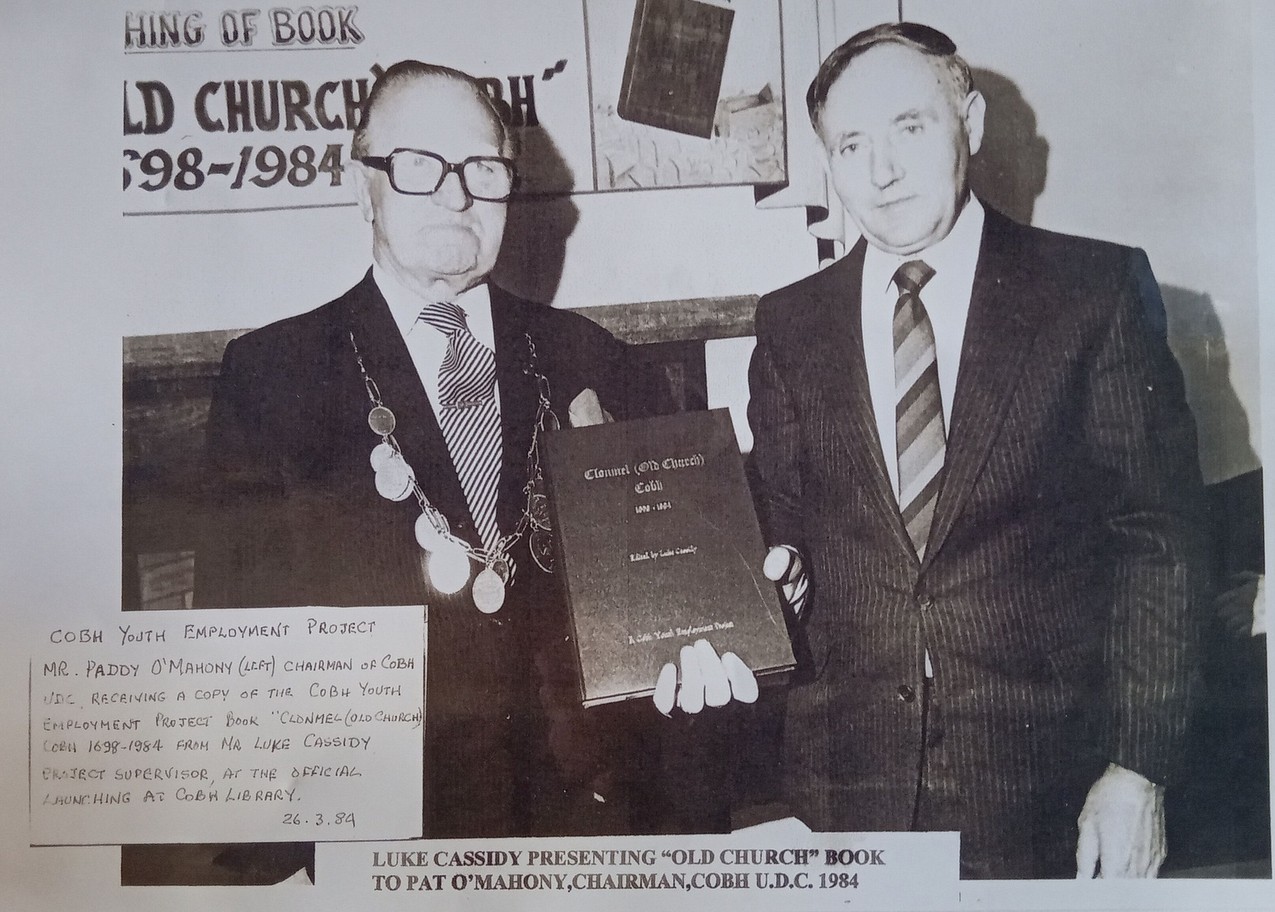
Taken From The Records Book:
It is impossible to say definitely when a church was first erected on this site. We can presume that it existed as part of the Celtic Church before the arrival of the Normans.
Henry the second on coming to Ireland divided the country between his Generals and that part of Munster that included the Great Island he gave to Robert FitzStephen. This Robert FitzStephen made a gift of half the Great Island to Margaret, daughter of Milo de Cogan on her marriage to his son Ralph. it is recorded in the register of St. Thomas’s Abbey in Dublin that she made a grant of the Church of Clonmel on the Great Island to that abbey.
The Church of Clonmel remained a place of Catholic worship until after the defeat of the Earl of Desmond and the collapse of the rebellion of 1581. The Creat Island was then left at the mercy of Lord Ormond and his English Army and on their arrival on the Island they signaled their victory by burning down the Old Church of Clonmel. It was taken from Catholic control and in a report of a visitor to the area in 1615 it was stated that the church was in ruins at the time.
In about 1694 a Protestant Church was built upon the walls of the Old Church and in the “Diocean Records” of 1700 it was stated that 50 pounds out of the increased rent of the Rectory and the Glebe of Clonmel was to be expended in adorning the east end of the church. It remained a place of Protestant worship until it was decided to build a new Protestant Church in the town and when this Church of St. Mary’s was completed in 1815 the Old Church was allowed to fall into ruins.
Around the Old Church is one of the most cosmopolitian graveyards in Ireland. Buried here are people of many races and creeds. Very many of them being men who went down to the sea in ships and found their last resting place in this quite corner of the Great Island.
For centuries, birth and landed wealth were the pre-requisites for the right to burial within the walls of a church and the right to erect a memorial..So called ordinary people were buried in the churchyard with only mounds of grass or pieces of wood to mark their graves. It was only when the new merchant classes arose in the late 1600’s that we find that although they were still restricted to burial in the churchyard itself they were rich enough to assume a tradition of erecting stone memorials to their dead. This is one of the reasons why we find so few headstones with dates before the 17th century.
HEADSTONE INSCRIPTIONS
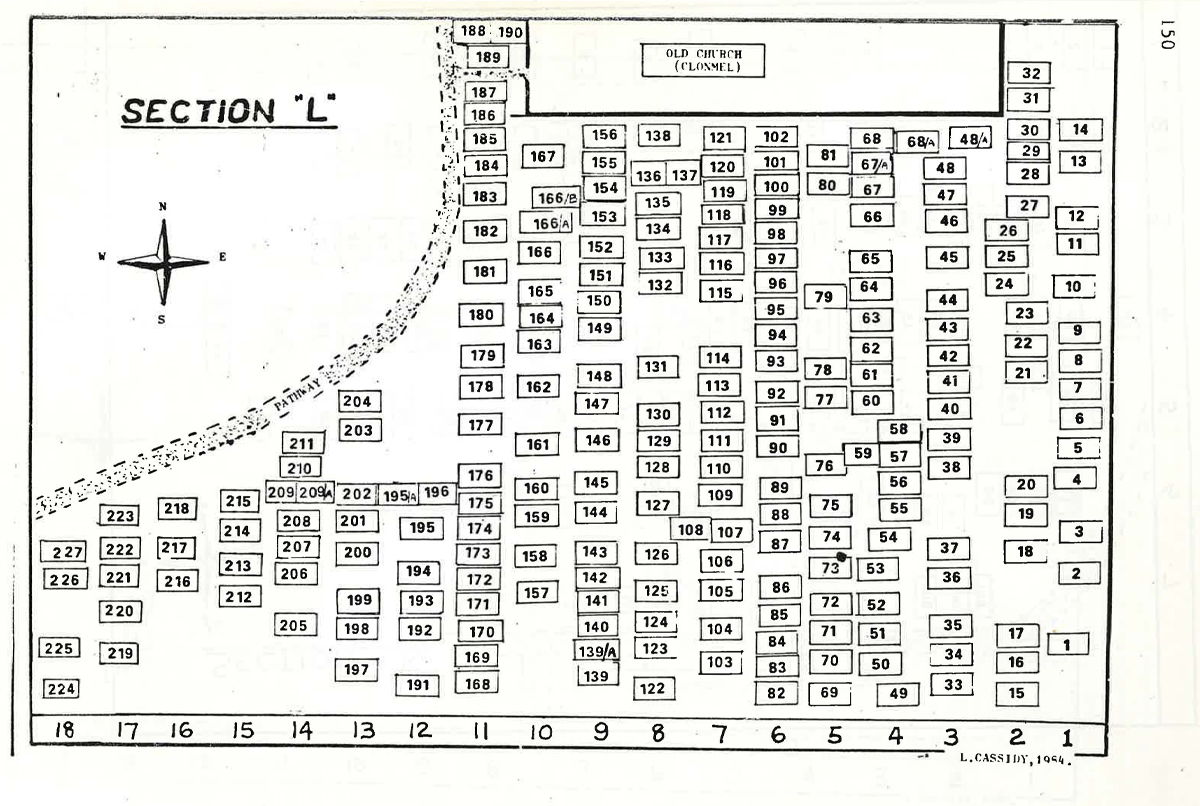
The following pages list a few of the many interesting graves and the inscriptions on the tombs, plaque’s and headstones. Starting in the oldest area around the church itself. NOTE: The numbers on the general map of the graveyard give the positions of these graves.
The oldest headstone in the cemetery (number 1 on the map) is just outside the west wall of the church on the left of the door as you enter. It is dated 1698 and even to-day can be clearly read. The inscription is as follows:-
Here lyeth the body of Stepen Towse who departed this life the 26 day of October 1698 also his wife Eliza Towse who departed Her life the 10 day of February and in the 84 year of her age ANNO DOMINI 1713
Inside the church walls, just to the left (number 2 on the map) is the grave of the Rev. Charles Wolfe the poet made famous by his poem “The burial of Sir John Moore at Corunna”. He also had many more poems and songs, some of which were published in “Barry’s Songs of Ireland”.
Charles Wolfe entered Trinity College in 1809 and took his B.A.degree in 1814. In November 1817 he was ordained minister but failed to obtain a fellowship in Trinity College. When friends of the woman he intended to marry advised her against doing so owing to his lack of wealth he went north and settled down as a curate.
In 1821 he got ill and went to Bordeaux to try and recover his health and in November 1822 he came to Cove for the same reason, The epitath on his tomb is as follows:-
Here lies the remains of Reverend Charles Wolfe/late curate of Donoughmore, who died at Cove/21st. February, 1823/The record of his genius, piety and virtue,/lives in the hearts of all who knew him/Looking unto Jesus, he lived, Looking unto/Jesus he died, He is not dead but sleepth.
To the right of the doorway (number 3 on the map) is the tomb of the Countess of Huntington with the inscription:-
Elizabeth Anne Countess of Huntington. Born 29th. May 1817 Died Feb. 18th.1857 aged 39 Rev.XIV 18 2nd.Con.V I.
Lady Huntington was the daughter of Richard Power M.P. of Clashmore Co.Waterford.
On the south wall of the church (number 4 on the map) is a tablet to the memory of John Tobin the dramatist who wrote “The Honeymoon” and who died on a ship off the harbour on his way to the West Indies in 1804.
The inscription reads:-
Sacred to the memory/of/John Tobin. Esq. of Lincoln Inn/whose remains are deposited under/the adjacent turf/He died at sea/near the entrance of this harbour/In the month of December/1804/On his passage to a milder climate In search of better health/aged 35/That with an excellent heart/And a most amiable disposition/He possessed a vigorous imagination/And a cultivated understanding/His dramatic writings/evince.
At the north-east corner of the church (number 5 on the map) is a marble tablet to the memory of George Rogers of Ashgrove. This tablet once had fine gold lettering.
Here lie/the remains of/George Rogers of Ashgrove Esq. who departed this life/May 11th. Anno Dom 1710/in the 61st.year of his age/His first wife Anne Atkins/his second wife Mary Wakeham/The children by his first wife/Waliving at the time of his death/were Francis, Robert, William, Joseph/and Mary wife of Edward Webber/His daughter Kathleen/departed this life in Bristol/27 Jan./By his second wife/he had only one daughter/Lucy/wife of Emanuel Piggott.
Outside the church close by the north wall (number 6 on the map) is a stone to the memory of the ill-fated crew of H.M.S.”Lapwing”. They died victims of a virulent dysentry between 13th. Dec.1804 and the 7th. Feb.1805.
To the north of this grave in section “J” (number 7 on the map) is a tomb with this inscription:-
Sacred to the memory/of Elizabeth Helsham/second daughterof/Lieut-Col. Conway/of H.M. 53 Reg./and great, great, great/grand daughter of/Margaret, second daughter of John of Gaunt/Duke of Lancaster/and wife of Geo. Helsham Esq./of City of Kilkenny/Capn.in H.M.Service/died 26th.Sept.18417 aged 33 years.
A large tomb to the south of the church (number 8 on the map) is that of Dr.James Roche Verling (Surgeon to Napoleon).
James Roche Verling was born in Cove on 27th. Feb.1787 and was the second son of John Verling and his wife Eleanor Roche. He began his medical career in Dublin and on the 12th. Dec.1809 he graduated as a doctor of medicine at Edinburgh University at the age of 23. He recieved a commission in the Army on 25th. Jan.1810 and was stationed at Ballincollig. Later, appointed to the Royal Artillery, he was sent to Portugal for the Peninsular War. Next promoted to Ass. Surgeon he was ordered to St. Helena.
On the 8th. Aug.1815 he sailed on the “Northumberland” as it carried Napoleon into exile. Later on St. Helena he was appointed Surgeon to Napoleon. He left the island of St. Helena 25th. Apr.1820 and served in Malta, Ionian Is.and Nova Scotia. Promoted up the ranks he became Inspector-General in 1854 and then retired. He returned to Cove and resided at Bellavista where he died on Jan. 1st.1857. Aged 71 years.
Alongside the main pathway in the old area (number 9 on the map) is a headstone with fine chiselled carving of sailing ships and a good example of the stonemason’s art. It was erected to the memory of William Donovan who was killed by grapeshot while leading his ship “Modeste” into battle in 1808.
Just south of the church (number 10 on the map) is a headstone to the memory of Dominick Sarsfield who once owned Ballydulea.
Also to the south of this is the second oldest headstone. It was erected to the memory of a Mary Ryan and is dated 1700. Mary was a child of two years. This is number 11 on the map.
In section “N” well to the north of the church (number 12 on the map) is a now broken headstone to the memory of James Ramsay Akers Smith who fought as an Ensign with the 14th. Foot Reg. at the battle of Waterloo.
In section “J” (number 13 on the map) is a stone erected by the crew of H.M.S.”Virginia” to the memory of William Delaney who was killed in a battle with a French Privateer in 1807.
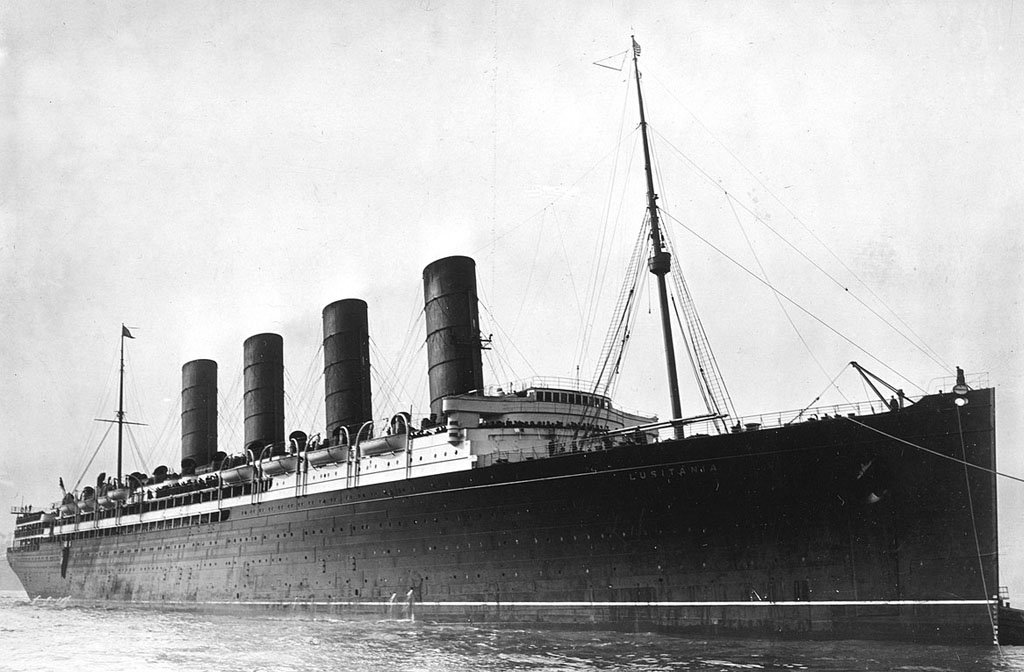
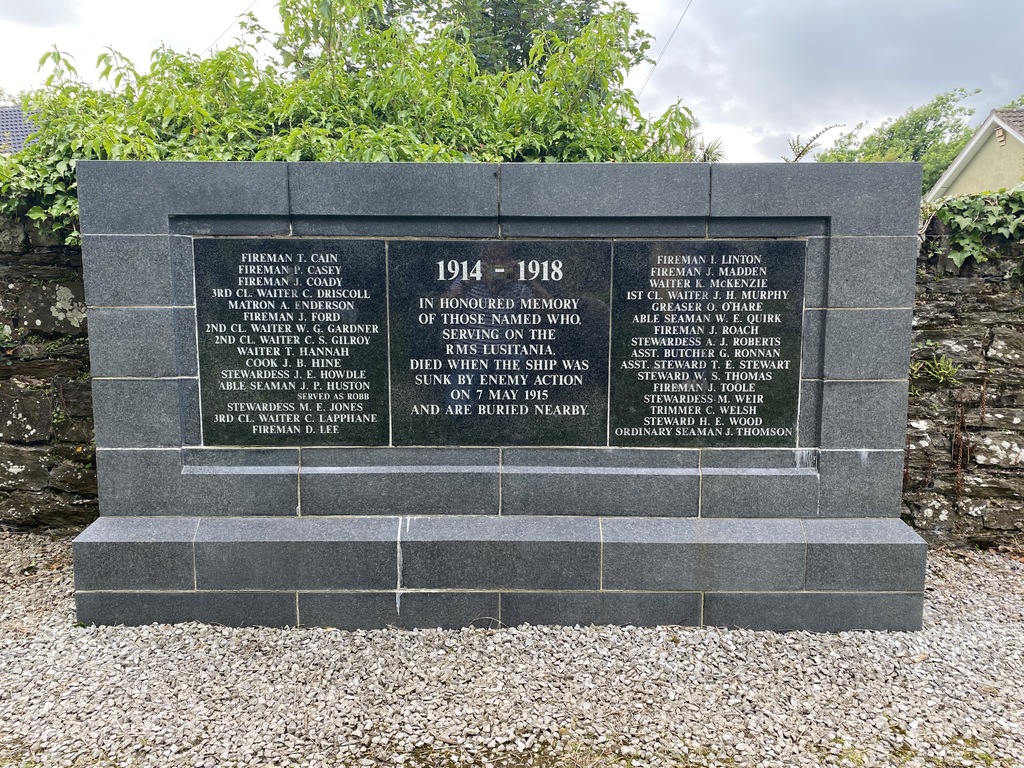
In 1850 it was decided that a new area would have to be added to the churchyard. It was in this area that the largest single burial took place. The three massed graves (number 14 on the map) of the victims of the sinking of the Cunard Liner “Lusitania” off the Old Head of Kinsale on 5th. May, 1915. In these massed graves and in 24 private graves 170 of those who lost their lives are buried.
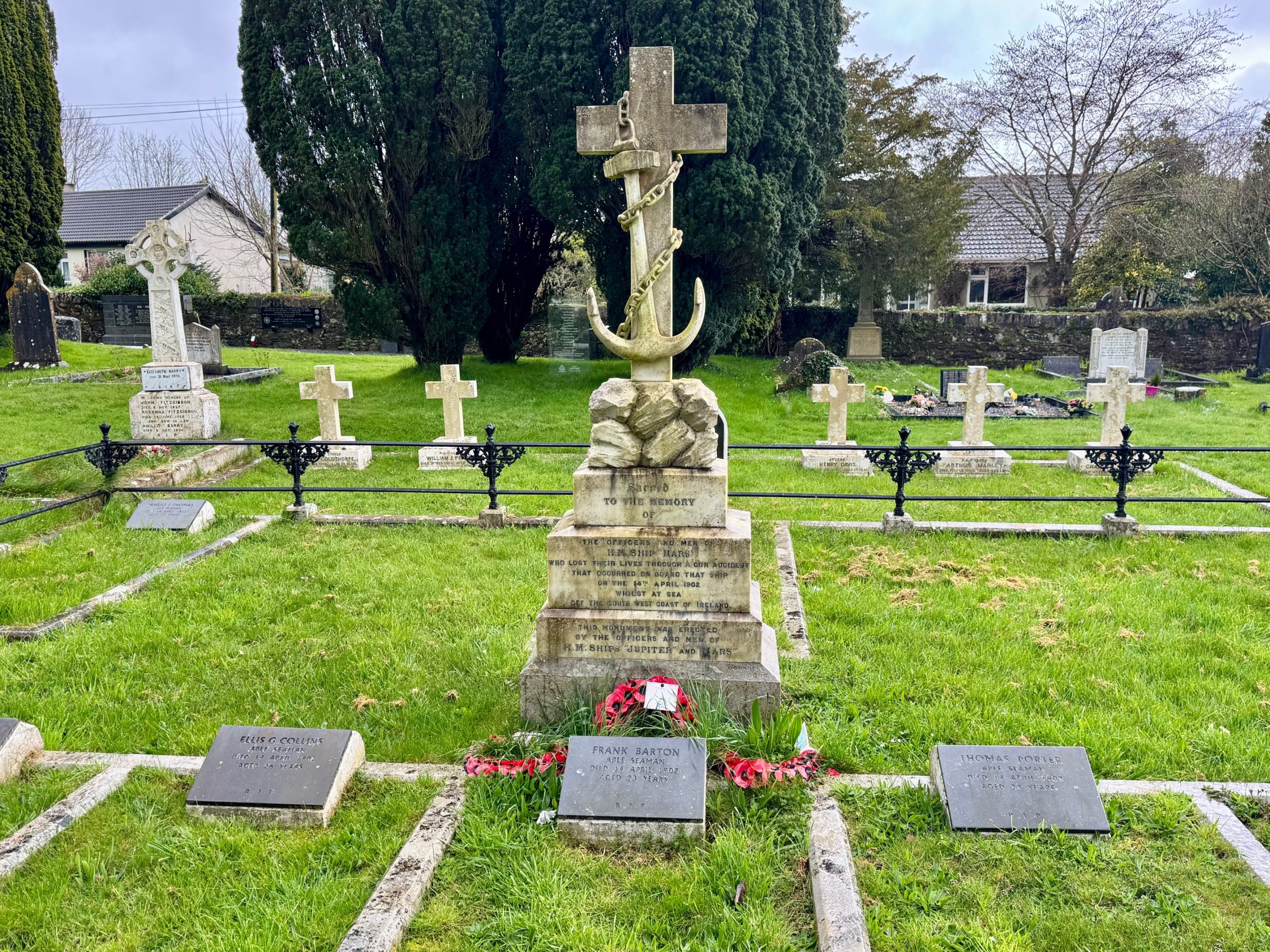
Close by (number 15 on the map) are five small white crosses that mark the burial place of the victims of an explosion in a very early type submarine on 16th. Feb.1905. In front of these crosses is an enclosed area that contains the graves of the victims of a gun accident on board H.M.S.”Mars” on the 14th. April, 1902.
In this section of the Old Church graveyard is a fine Celtic Cross (number 16 on the map) erected to the fond memory of men who lost their lives in service of their country during the War of Independence.
Vol. James Glavin I.R.A. Killed in action 1921.
Capt. James P.Aherne I.R.A. Killed in action 1921.
This new area has been used for burials since 1930 and it is in this section that Jack Doyle (No.18 on the map) is buried. Born in Cobh, He was to become a World famous boxer and when he died in London his remains were brought back for burial in his native town.
TO FIND A REQUIRED GRAVE
The very old records of the Old Church cemetery are very scant in the details that are recorded. Large numbers of unmarked graves exist and all that the records state in a lot of cases is “Son”, “Daughter” or “Wife” of a named person, “A child of a soldier”, “A drowned man”, “A Dutch sailor”, “A black servant”,”An unknown person”, “Convicts bound for Botany Bay”.
Many strange names figure in recorded lists. Most are the names of sailors from the sailing ships that came to the harbour in years passed. Others are of soldiers, their wives and children.
Spelling of many names differ in records and also some well known present day names are recorded in a number of different ways.
Names in this book have been recorded as they were found.